
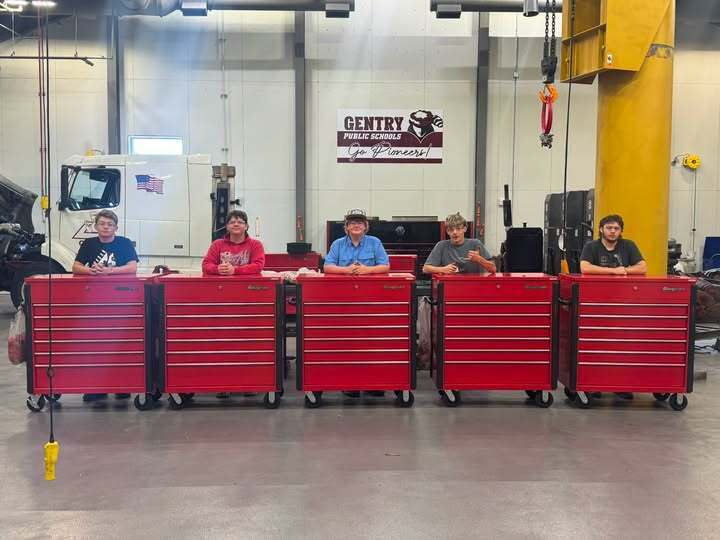
GENTRY, AR — A row of brand-new Snap-on toolboxes may not look like a traditional classroom supply, but for students in Gentry High School’s Diesel Technology program, they represent something much bigger: an investment in skills, careers and the future workforce.
Gentry’s Diesel Technology students, taught by instructor David Williamson, have been issued their Snap-on toolboxes for the school year. The professional-grade equipment will give students the opportunity to work with the same type of tools they may encounter in professional diesel and mechanical careers.
“This is about giving our students more than just a textbook or a worksheet,” Williamson said. “They’re learning how to use professional tools, solve problems, work safely and take pride in the work they’re doing. Those are skills they can take with them wherever they go after high school.”
The Diesel Technology program is housed in Gentry Public Schools’ 13,000-square-foot Career and Technical Education Center, which opened in 2017. The facility includes a dedicated Diesel Lab and a five-ton jib crane and was designed to provide students with hands-on preparation for technical careers.
The program is one example of why Career and Technical Education is an important part of a comprehensive high school education.
Not every student’s path after graduation looks the same, and it shouldn’t. Some students will pursue a four-year college degree, while others may choose technical education, certifications, apprenticeships, military service, entrepreneurship or enter the workforce directly after high school.
CTE programs give students opportunities to explore those pathways while they are still in high school. Students can connect classroom concepts to real-world applications, develop technical and workplace skills, and gain experience that can help prepare them for careers.
Arkansas has increasingly emphasized the importance of career readiness and CTE as part of preparing students for life after high school. The state requires every public high school to offer CTE pathways, including pathways connected to high-demand and high-wage occupations. But Gentry has gone the extra mile.
Gentry’s Diesel Technology program is particularly focused on an industry where skilled technicians are needed. Students who complete the program graduate with practical experience that can help position them for employment in diesel mechanics and related fields. Gentry has previously reported that students completing the program have gone directly into the workforce, while interest in the program has continued to grow.
For Williamson, the value of the program goes beyond teaching students how to repair diesel-powered equipment.
“We want our students to leave here knowing they can do something important to our world,” Williamson said. “They can take what they’ve learned, continue their education, go to work, start a business or build a career. Our job is to give them the skills and confidence to take that next step.”
That philosophy reflects a broader goal of Gentry Public Schools: preparing students for success regardless of which path they choose.
Sometimes learning happens behind a desk. Sometimes it happens in a laboratory, a welding booth, an agricultural setting or a diesel shop.
For Gentry’s Diesel Technology students, it happens with real tools in their hands.
And those Snap-on toolboxes are more than equipment. They are an investment in students, an investment in workforce development and an investment in the future of Gentry and the surrounding community.